Treatment
These are the approved guidelines published by the South African Society of Psychiatrists to provide an overview on treatment and management of commonly diagnosed psychiatric illnesses. The guidelines include consensus recommendations, based on peer contribution and using the international evidence based guidelines that are suitable for the local South African health service.
Please note that parts of this guideline may be out of date, an update will be published as soon as it is available.
Continuation and maintenance treatment
Managing partial and non response
Treatment goals
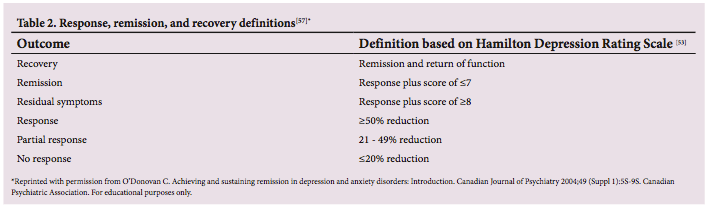
Definitions of response, remission, and recovery[2] are summarised in Table 2.[57] In depression, full remission is defined as the virtual elimination of symptoms which in most clinical trials refers to depression scores within the normal range. This is most consistently defined as a score of 7 or less on the 17-item Hamilton Depression Rating Scale (HDRS-17). The term ‘response’ generally indicates a 50% reduction in depression score. Recovery from depression is often equated with remission in the literature. It is also variably defined as remission for an extended period of time or the complete absence of symptoms and improved work and psychosocial functioning.
Evidence for the benefits of treating to remission in depression is clear: remitted patients are more likely to regain full functional recovery and to suffer fewer relapses and recurrences.[58] Remission has become the accepted treatment goal in MDD, as seen in many recent clinical trials. In the current National Institutes for Mental Health Sequenced Treatment Alternatives to Relieve Depression (STAR*D) trial, for example, anything less than remission was viewed as treatment failure.[59,60]
General aspects of treatment
Treatment consists of an acute phase (during which remission of all symptoms is induced); a continuation phase, during which remission is preserved; and a maintenance phase during which susceptible patients are protected against the recurrence of subsequent major depressive episodes.[1]
Acute treatment
Initial management of MDD should entail: the establishment and maintenance of a therapeutic alliance; education of the patient and the family about the disorder with provision of information about treatment options; a review of the possible adverse effects of medications and potential drug-drug interactions; emphasis of the importance of taking medication as prescribed; and addressing the early signs of relapse.[61] The appropriate treatment setting (inpatient or outpatient) should be selected and the treatment plan should be individualised to the patient’s needs.[62]
Treatment decisions should also importantly take into account depression severity. A mild depressive episode, according to the DSM-IV-TR,[37] is characterised by 5 or 6 symptoms or less and mild disability (social, occupational and other important areas of functioning), a moderate depressive episode by 6 or more symptoms and moderate disability, and a severe depressive episode by most of the symptoms (as per the DSM-IV-TR symptom list) and observable disability. According to the DSM-IV-TR, subthreshold depression comprises fewer than 5 symptoms.[37]
Guidelines differ in their opinion on the management of mild depression. The APA guidelines[1] advise psychotherapy or antidepressant monotherapy based on patient preference. Similarly the CANMAT guidelines[2] recommend either cognitive-behavioural therapy (CBT), cognitive therapy, interpersonal therapy (IPT), or antidepressants as a first-line treatment, while the BAP guidelines[63] recommend CBT behavioural therapy with activity scheduling, IPT or an antidepressant.
For moderate depression, all guidelines accept the use of an antidepressant or evidence-based psychotherapy as a first-line choice, with the exception of the NICE guideline which recommends antidepressants as the only first-line choice.[3,64] In view of their superior tolerability and safety, the selective serotonin reuptake inhibitors (SSRIs), serotonin-norepinephrine reuptake inhibitors (SNRIs), or the norepinephrine-dopamine reuptake inhibitors (NDRIs), and mirtazapine are encouraged over the use of the tricyclic antidepressants (TCAs) and the monoamine oxidase inhibitors (MAOIs). However, the following considerations apply in deciding on the most appropriate medication: availability, safety and tolerability, patient preference and patient needs, and cost.[65] Newer antidepressant classes such a melatonin agonist may also be employed. Moderate depression may necessitate a combination of both an antidepressant and psychotherapy (either CBT or IPT). The APA guidelines recommend a combination of antidepressants and psychotherapy for patients with significant psychosocial problems or Axis II disorders and/or poor compliance.[1]
For severe depression, the guidelines concur that the following first-line treatment options apply: (i) a combination of an antidepressant and psychotherapy (either CBT or IPT); (ii) electroconvulsive therapy (ECT) (6 to 10 treatments, maximum of 20, WFSBP guidelines recommend bilateral rather than unilateral ECT); or (iii) a combination of an antidepressant with an antipsychotic agent for a major depressive episode with psychotic features.[62] In addition to using SSRIs as first-line agents, the WFSBP guidelines[6] also recommend TCAs and SNRIs as first-line options for severe depression. The RANZCAP guidelines[4] suggest a TCA or venlafaxine, an SNRI, as first-line treatment with lesser evidence for use of the SSRIs as first-line therapy. The RANZCAP guidelines also recommend the use of phenelzine or CBT for depression with atypical features. The BAP guidelines[63] do not consider psychotherapy alone as adequate for acute severe depression and recommend the use of an antidepressant as a first line. The aforementioned guidelines do not consider repetitive transcranial magnetic stimulation (rTMS), vagal nerve stimulation (VNS), hypericum extract (St John’s wort) or omega 3 supplementation as first-line treatments for severe depression, but consider light therapy as first-line treatment for seasonal affective disorder (SAD).
Pharmacological treatment
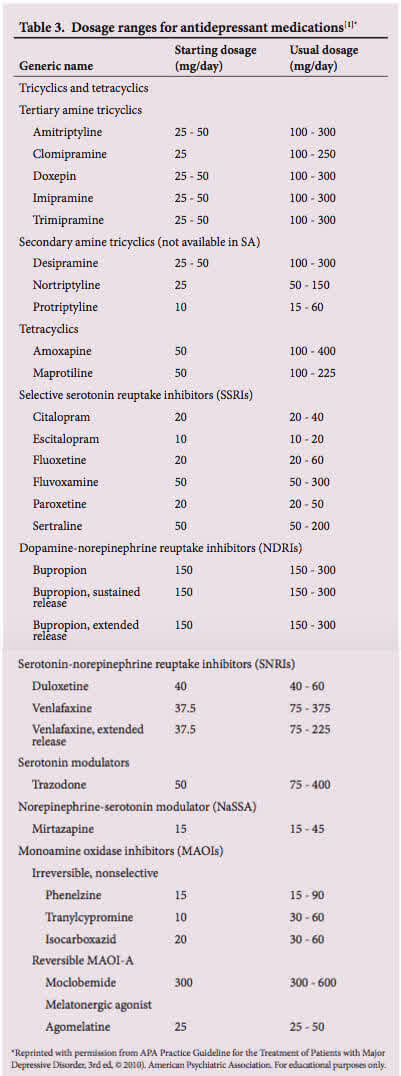
Dosage ranges for antidepressant medications are summarised in Table 3.[1] In order to improve tolerability, it may be necessary to initiate the patient on a subtherapeutic dose of an antidepressant (e.g. 10 mg fluoxetine) with gradual titration up to therapeutic dose levels. A medication trial should be of adequate dose and duration (i.e. 8 - 12 weeks). Cognisance should be taken of pharmacodynamic and pharmacokinetic properties of the selected antidepressant, and the expectation that efficacy may only be achieved following several weeks of treatment. The principle of ‘what gets you well, keeps you well’ should be kept in mind.
The patient should be monitored at regular intervals (fortnightly) to assess clinical status, response, side-effects, and safety, including worsening or emergence of suicidal ideation. Response can be assessed using a measurement-based tool such as the Clinical Global Impressions Scale (CGI). In addition to monitoring response of depressive symptoms, overall change in functioning, disability and subjective well-being should also be ascertained. If side-effects are intolerable, the patient should be switched to an alternative. Mirtazapine and bupropion, for example, may be useful in patients who experience SSRI-induced sexual dysfunction.
In general benzodiazepines (which do not have specific antidepressant effects) are not recommended as monotherapy and should be used judiciously as short-term adjunctive therapy (i.e. not longer than 4 weeks) to manage symptoms of anxiety, insomnia, and agitation[66] on an as-needed basis. Benzodiazepines should be avoided in patients with comorbid substance-use disorders.
Continuation and maintenance treatment
According to APA guidelines, the continuation phase is defined as the 16 - 20-week period that precedes sustained and complete remission from the acute phase. To prevent relapse, antidepressant medication should be continued at the same dose used during the acute phase. The aforementioned guidelines recommend that the frequency of visits be dictated to by the patient’s condition and the specific treatment. Frequency can vary from once every 2 - 3 months to a few times per week.
On average, 50 - 85% of patients with a single episode of MDD will have at least one more episode. Therefore, following the continuation phase, maintenance phase treatment should be considered to prevent episodic recurrences. The following issues need to be borne in mind when considering maintenance treatment:
- The risk of recurrence (based on the number of previous episodes, presence of comorbid conditions, and residual symptoms between active episodes)
- The severity of episode(s) (based on the presence of suicidality, psychotic features, level of functional impairment)
- Side-effects associated with continuous treatment
- Patient preference.
The precise timing and methods of discontinuing psychotherapy and pharmacotherapy for depression have not been systematically evaluated. The decision to discontinue maintenance treatment should be based on the same factors guiding the decision to initiate maintenance treatment, including the probability of recurrence, the frequency and severity of past episodes, the persistence of depressive symptoms after recovery, the presence of comorbid disorders, and patient preference.
Non-pharmacological treatment
Non-pharmacological alternatives include psychotherapy (e.g. CBT, IPT) and newer alternatives that work on the basis of electric currents or magnetic impulses such as ECT, rTMS, VNS, and deep brain stimulation (DBS). Both CBT and IPT have been shown to be effective in acute depression (as monotherapy in mild depression and as augmentation in moderate and severe depression), and in preventing relapse and recurrence.[65] ECT should be considered in patients with severe depression, in patients with depression with psychotic features, and in special circumstances or emergency situations.[67] rTMS, VNSand DBS are not recommended as first- or second-line treatments in MDD.
Special populations
Subtypes
MDD may present with melancholia, with psychotic features, with atypical features, with catatonia, or as SAD. MDD with melancholic features is characterised by anhedonia, lack of reactivity to pleasurable stimuli and typical neurovegetative features such as worsening of mood in the morning, early morning waking, and marked weight loss.[1] Although data are inconsistent, there is some evidence that venlafaxine and TCAs may be more effective than SSRIs for this depressive subtype. As mentioned previously, depression with psychotic features responds to the addition of an antipsychotic; however ECT is also an effective first-line option.[67]
Atypical depression is characterised by mood reactivity, significantly decreased energy or leaden feelings in the limbs (leaden paralysis), heightened sensitivity to interpersonal rejection, and a reversal of neurovegetative symptoms (increased sleep and appetite). SSRIs are considered first-line agents but monoamine oxidase inhibitors (MAOIs) are also effective (the latter have demonstrated superior efficacy to the TCAs).[68] In these patients, it is important to consider medication that has a lower propensity for sedation or weight gain or a switch to mania. SAD, a subtype characterised by autumn/winter depressive episodes and spring/summer hypomanic episodes, responds to both antidepressants (e.g. SSRIs) and light therapy. Both of the aforementioned treatments may be used as first-line, either separately or in combination.[69] The extended release formulation of bupropion is US Food and Drug Administration (FDA)-approved for use in patients with this subtype (i.e. seasonal MDD). In patients with catatonia, ECT has been shown to be effective.[70] Intravenous administration with a benzodiazepine (e.g. lorazepam, diazepam) may also induce rapid relief.[71]
Comorbidity
Patients with coexisting dysthymic disorder usually have a better response to a combination of an antidepressant and psychotherapy than to either treatment alone. In patients with comorbid anxiety disorders, SSRIs or SNRIs are a good first choice.[72] In addition, short-term augmentation with a benzodiazepine may be warranted and may also assist in enhancing compliance. In patients with comorbid panic disorder, it is prudent to start off with lower dose of an SSRI; in patients with comorbid obsessive-compulsive disorder (OCD) a serotonergic agent (SSRI or clomipramine) is advised; and in patients with comorbid social anxiety disorder, an SSRI or venlafaxine but not a TCA should be used.[73,74] Psychotherapies such as CBT, behavioural therapy, and IPT may also be used to treat anxiety disorders and symptoms in this setting. Substance use disorders are often comorbid with MDD and in these patients an SSRI would be a good optional though it may be necessary to detoxify these patients and then treat the substance use disorder first. For patients with comorbid borderline personality disorder, an SSRI or SNRI, should be considered. The behavioural impulsivity and dyscontrol can also be treated with a low-dose antipsychotic, lithium, or an antiepileptic medication.[75]
In patients with comorbid medical disorders, the choice of antidepressant medication and the potential for multiple interactions with other medications need careful consideration; for example, in patients with cardiac disease TCAs should be avoided while in patients with stroke or epilepsy an SSRI is preferred.[76] In HIV-infected patients, SSRIs are a preferred choice and are better tolerated than TCAs. For those patients on antiretroviral treatment, it is important to check for potential drug-drug interactions when choosing an antidepressant.[77]
Suicidality
Debate about the risks of suicidal ideation and attempts following the initiation of antidepressant treatment continues. It is well known that as mood begins to improve on antidepressant treatment, so too do neurovegetative symptoms, energy and psychomotor activity.Patients may, therefore, act on pre-existing suicidal intent.[78] Recent meta-analyses of data from clinical trials have shown a statistically significant increase in suicidal thoughts or behaviours in depressed individuals aged 25 years or younger treated with antidepressant medications, compared with placebo, with a 1.5- to 2.5-fold increase in the relative risk.[79,80] In contrast, no change in risk was detected for adults aged 25 to 64 years, while older adults (aged 65 years or older) on antidepressant treatment showed a decrease in the risk of suicidal thinking or behaviours. All antidepressants, in accordance with an FDA directive, carry a black-box warning that advises of the increased risk of suicidal thinking and behaviour pertaining to children, adolescents, and young adults.[81]
Pregnancy and lactation
Both antidepressant use and untreated depression in pregnancy carry their own set of risks. Any decision to commence, continue, or discontinue an antidepressant needs to weigh up the risks and the benefits to mother and infant. Furthermore, it is important to bear in mind that relapse rates for women with a history of MDD are high during pregnancy, especially when antidepressants are discontinued.[82]
The risk of teratogenicity with antidepressants following first-trimester exposure appears to be low overall. However, some rare birth defects have been observed to occur at higher rates with the use of specific SSRIs. For example first-trimester paroxetine exposure has been associated with cardiac malformations, a finding that resulted in changes in FDA labelling for paroxetine. Although most earlier reports[83] suggested that SSRIs were not associated with a greater risk of congenital malformation, Chambers et al.[84] have since shown that SSRIs can adversely affect fetal development. Antidepressant use in late pregnancy has been shown in some, but not all, studies to result in medical complications such as prematurity and transient neonatal withdrawal/adaptation syndrome.
ECT is both safe and effective during pregnancy and should be considered in pregnant women with moderate to severe depression who are unresponsive to, or unsuitable for, pharmacotherapy, for pregnant patients with psychotic features, and for pregnant patients who prefer this modality. MDD with postpartum onset is defined, in the DSM-IV-TR, as a major depressive episode with onset within 4 weeks of delivery. Antidepressants can be prescribed for postpartum depression, in accordance with the same treatment principles delineated for other types of MDD.[85]
While long-term evidence on the risks and benefits of antidepressant use during lactation are as yet not available, existing data suggest that antidepressants are compatible with breastfeeding. There have been case reports of adverse effects in breastfeeding infants exposed to maternal antidepressants but most studies have indicated low levels of exposure via breast milk with the SSRIs. The exception to this is fluoxetine, which appears to have a dose-related risk for detectable levels in infant sera.[86]
Managing partial and non-response
Medication response may take 6 - 8 weeks or longer. If a first-line treatment has not worked after 8 weeks at an optimal dose (i.e.there is no response), most guidelines recommend a re-evaluation of symptoms and adverse effects before switching to another antidepressant from another class; for example, if a patient has had atrial of an SSRI then one should consider switching to an SNRI or to mirtazapine or bupropion.[87]
If a first-line treatment has partially worked (i.e. there is a partial response), then it is important to ensure that the patient is adherent and not experiencing intolerable side-effects. In this instance, the dose should be increased. If there is still no response after 4 - 6 weeks, it is prudent to consider combining the existing antidepressant with another antidepressant with a different mechanism of action (e.g. combining bupropion or mirtazapine with an SSRI, combining an SSRI with a TCA, combining venlafaxine with mirtazapine). Alternatively, augmentation strategies can be tried. These include the addition of lithium, an atypical antipsychotic, triiodothyronine (T3) or mianserin.[88]