Acute Pain
Description Medicine treatment ICD-10 code: R52.0 DESCRIPTION Acute pain is pain of short duration that usually resolves as injured tissues heal. Note: - Do not hesitate to start with opioid analgesia in cases of severe pain. - Always reassess the degree of response and adjust management accordingly. MEDICINE TREATMENT The correct use (dose, scheduling, duration) of the correct analgesic wi
ICD-10 code: R52.0
DESCRIPTION
Acute pain is pain of short duration that usually resolves as injured tissues heal.
Note:
- Do not hesitate to start with opioid analgesia in cases of severe pain.
- Always reassess the degree of response and adjust management accordingly.
MEDICINE TREATMENT
- The correct use (dose, scheduling, duration) of the correct analgesic will relieve most pain in children.
- Multimodal analgesia employs a variety of treatment strategies, both medicine and non-medicine, targeting multiple receptors involved in nociception. This facilitates improved pain control, while allowing for reduced doses of agents with unfavourable side-effect profiles (e.g. opioids). Adjuvant agents include local anaesthetics, simple analgesics, opioids, α2 receptor agonists (clonidine), NMDA receptor antagonists (ketamine, magnesium sulphate), and anxiolytics.
Simple analgesics
This includes paracetamol, NSAIDs and local anaesthetic agents. They are generally safe, provided dosing instructions and other cautions are adhered to, with favourable side-effect profiles. These agents should be considered as part of any analgesic strategy. They reduce the amount of opioid needed to achieve equivalent levels of analgesia.
- Paracetamol:
- Oral paracetamol is the preferred route of administration. It is cheap and effective, and considers the placebo effect.
- IV paracetamol should be reserved for patients who cannot receive oral paracetamol, i.e. those with gastrointestinal pathology causing poor absorption or not allowing for feeding.
- Rectal route can be considered in patients who are unable to take oral medicines, where IV access is not available. Administration via the rectal route should be avoided in children with neutropenia.
Note:
Suppositories should not be cut into pieces, as the amount of paracetamol in each portion may not be consistent.
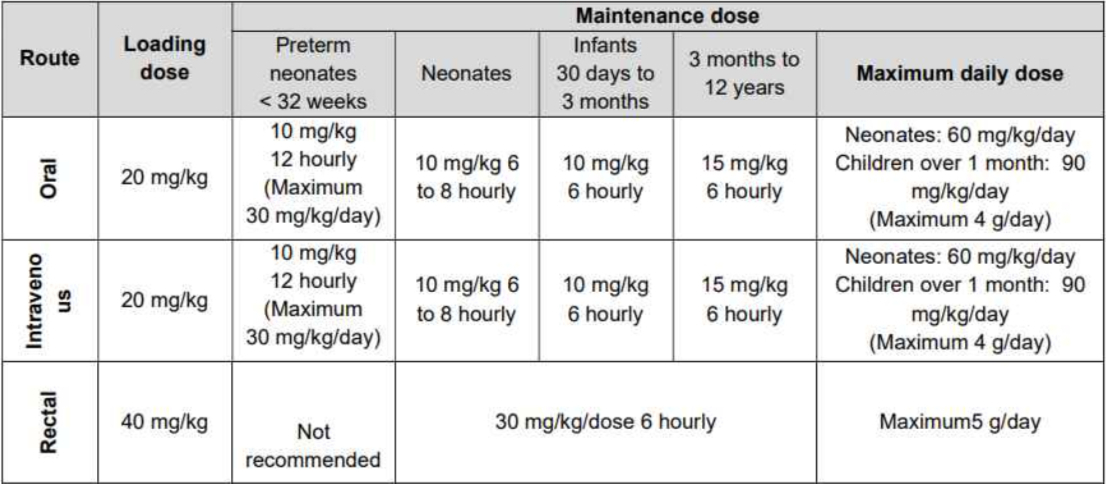
Click on the table to enlarge
- Avoid prolonged use of paracetamol.
- Caution and dose reduction needs to be considered when administering paracetamol to chronically sick or malnourished children.
Non-steroidal anti-inflammatory drugs (NSAIDS)
These should be considered as part of any analgesic strategy. Serious adverse events after NSAIDs are rare in children aged ≥ 6 months of age.
Children over 3 months of age can safely receive ibuprofen.
Due to the risk of Reye Syndrome, aspirin should be avoided.
- Ibuprofen, oral, 5–10 mg/kg/dose 6–8 hourly with meals.
- Maximum daily dose is 40 mg/kg/day.
- Can be used in combination with paracetamol and opioids.
Opioid therapies
Opioid medicines are essential in the management of moderate and severe pain. Unfortunately, fear and lack of knowledge about the use of opioids in children are often barriers to effective relief of pain and suffering.
Opioids
- Morphine, oral [Immediate release morphine (liquid)]:
If 0–1 month of age: 0.05 mg/kg 6 hourly.
If > 1–12 months of age: 0.1 mg/kg/dose 4–6 hourly.
If > 12 months of age: 0.2–0.4 mg/kg/dose 4–6 hourly.- Onset of action: 20–40 minutes.
- Time to peak action: 60–90 minutes.
- Duration of action: 3–6 hours.
- Neonates and patients with hepatic and renal dysfunction may require dose modification – specialist consultation.
- Morphine, IV:
- IV morphine is indicated if pain is severe, or the patient is unable to take oral morphine. Titrate morphine slowly to achieve pain control and avoid side effects. Give small doses at 5–10 minute intervals, with frequent reassessment.
- Time to peak action: 20–40 minutes.
- Duration of action: 4–6 hours.
- For infusions: Morphine 0.5 mg/kg diluted up to 50 mL with dextrose 5% or sodium chloride 0.9%. 1 mL = 10 mcg/kg.
- Give morphine bolus slowly over 3–5 minutes.
Table: Dosing guide for IV morphine
| Age | 4 hourly bolus dosing (mg/kg) | Infusion dose (mcg/kg/hour) | mL/hour* |
| Neonate | 0.025–0.05 | 5–10 | 0.5–1 |
| 1–6 months | 0.05 | 10–30 | 1–3 |
| 6 months–1 year | 0.05–0.2 | 20–30 | 2–3 |
| 1–12 years | 0.1–0.2 | 20–30 | 2–3 |
- Fentanyl, IV:
- Fentanyl is a strong opioid, 100 times more potent than morphine. IV fentanyl is the preferred agent in severe renal dysfunction or renal failure, and can also be used in patients with liver failure. Titrate fentanyl to achieve pain control and avoid side effects. Start at the lower dosing range in opioid naïve patients.
- Bolus dose: 0.5–2 mcg/kg, repeated at 30–60 minutes. Give bolus slowly over 3–5 minutes.
- Infusion dose: Give bolus dose, then commence infusion at 1 mcg/kg/hour.
- Onset of action: 1 minute.
- Time to peak action: 5.8 minutes.
- Duration of action: 30–60 minutes.
- For infusions:
- Neonates: 200 mcg/kg in 20 mL 5% dextrose: 0.1 mL/hour = 1 mcg/kg/hour.
- > 1 month: 20 mL neat fentanyl (50 mcg/mL). 0.1 mL/kg/hour = 5 mcg/kg/hour.
Managing opioid-related side effects:
Some side-effects are common and require prophylactic management. Fortunately, life-threatening side effects are uncommon, provided recommended dosing is adhered to. It is inappropriate to deny children appropriate opioid analgesia where indicated, due to fear of side-effects.
| Constipation | - Lactulose, oral, 0.5 mL/kg 12 hourly. - Also see: Constipation - Paediatric Palliative Care. |
| Nausea/vomiting | - Ondansetron, IV, 0.15 mg/kg 8 hourly. |
|
Management of opioid-induced respiratory depression
|
This is uncommon if safe prescription is adhered to – correct route/dose/scheduling. Indications for Naloxone: Instructions for administration: |
Monitoring in patients receiving opioids (in ward/high care/ICU):
A suitably trained nurse must be available to monitor, initiate management, and escalate care, or call a doctor when necessary. Resuscitation equipment must be readily available, checked, and in working order. Naloxone must be immediately available.
All patients receiving opioids should have the following monitored and documented:
- Heart rate.
- Oxygen saturation via continuous saturation monitoring for the first 15 minutes.
- Respiratory rate.
- Level of consciousness.
- Pain scores.
Frequency of monitoring:
- Observe closely for 15 minutes after administering the first opioid dose.
- Then do observations every 30 minutes for the first hour.
- Thereafter, observations must be documented 4 hourly.
Weaning from opioids
This must be done for any child who has received morphine for more than 5– 7 days. Wean by decreasing the daily dose by one third for 3 days.
Note:
Children receiving properly titrated doses of analgesics, including opioids, are unlikely to become dependent. There is a difference between tolerance, which is a need for escalating doses to achieve the same therapeutic effect, and addiction.
Adjuvant medicines used in pain management:
An adjuvant (or co-analgesic) is a drug that in its pharmacological characteristic is not necessarily primarily identified as an analgesic in nature but that has been found in clinical practice to have either an independent analgesic effect or additive analgesic properties when used with opioids.
Ketamine
Ketamine is an NMDA receptor antagonist known for its haemodynamic and respiratory stability. This agent should be considered for patients with high opioid requirements or opioid tolerance, or where there is a significant component of neuropathic pain (e.g. amputation, neurosurgical procedures with nerve injury, burns, mucositis, or severe surgical pain).
- Ketamine, oral:
- 4–6 mg/kg 4–6 hourly.
- Injectable formulation can be used, (concentration 100 mg/mL). It is bitter tasting, and should be mixed with a sweet-tasting substance e.g. paracetamol or ibuprofen.
- Onset of action: > 5 minutes.
- Time to peak action: 30 minutes.
- Duration of action: 4–6 hours.
- Ketamine, IV:
- 0.2–0.3 mg/kg/hour, IV, (2–3 mL/hour).
- Infusion: Mix 5 mg/kg of ketamine diluted to 50 mL with sodium chloride 0.9%. 1 mL = 0.1 mg/kg.
- Low dose ketamine delivered by IV infusion is safe and effective. It does not cause sedation, or any psychotropic effects.
- Onset of action: < 1 minute.
- Time to peak effect: 3–5 minutes.
Recommended multimodal pain management directed by pain severity (see pain assessment):
| Pain severity | Analgesia | Comments |
| Mild | Paracetamol ± NSAIDs | |
| Moderate | Paracetamol ± NSAIDs + Opioid: - Morphine, oral |
|
| Severe | Paracetamol ± NSAIDs + Opioid: - Morphine, oral or IV. OR - Fentanyl, IV. |
Titrate IV opioids for safety. |
| Adjuvant agents | Ketamine | Can be used with any pain severity. Recommended for moderate/severe pain. |
| Interventional modalities | Regional anaesthesia. See: Local and regional anaesthesia. | Consider indwelling catheters. |
Pain in children with severe neurological impairment (SNI):
Pain is a frequent problem in children with neurological impairment (from any cause), with the highest frequency and severity occurring in children with the greatest impairment. These patients are vulnerable to under-recognition and under-treatment of pain. Barriers to treatment include uncertainty in identifying pain, limited experience, and fear with the use of analgesics. A systematic approach to identifying a source of pain is suggested. The R-FLACC tool has been validated in this patient population for assessment of pain severity, but clinicians must note that this tool (and others) can underestimate pain in these patients.
Patients with SNI may suffer from neuro-irritability, which can be associated with pain. In a child with recurrent pain behaviour episodes (3 or more prolonged episodes per week or a monthly cycle of frequent episodes for 1– 2 weeks each month), initiate:
- Clonidine, oral, 1–3 mcg/kg 6–8 hourly.
- Amitriptyline, oral, 0.5–1 mg/kg 8 hourly.
- Maximum: 25 mg/dose.
Pain in children with burn injury:
Burn injury is often associated with severe pain. Pain severity is directly correlated with the extent of burn injury. In addition, anxiety and post-traumatic stress disorder can contribute to the pain experience. These should be actively managed with non-medicine therapies and medicine therapies where necessary.
Manage baseline pain according to severity – see pain assessment and recommended multimodal pain management (above). Patients with significant burns often develop tolerance to opioids, and often require higher doses of opioids in addition to adjuvant medicines. Procedural sedation and analgesia (PSA) should be optimised to minimise further anxiety, pain and distress, and is indicated for IV access and dressing changes. Dressing changes involving a large total body surface area (TBSA), or patients who have failed previous attempts at PSA should undergo procedures under general anaesthesia.
Neuropathic pain: medicine management
If a child reports features suggestive of neuropathic pain – i.e. pain that is sharp/stabbing/burning in nature, or paraesthesia – or the mechanism of injury or pathology is in keeping with nerve injury or neuropathic pain, a trial of amitriptyline can be considered.
- Amitriptyline, oral, 0.1–1 mg/kg 8 hourly.
- Start on a low dose and titrate up according to symptoms.
- Maximum: 25 mg/dose.
Standard Treatment Guidelines and Essential Medicines List for South Africa Paediatric Hospital _2023, 5th edition_Updated July 2024
Chapter 20: Pain Control, 20.1.1 Management of Pain , 20.1.1.1 Acute Pain