Cardiac Dysrhythmias
Standard Treatment Guidelines and Essential Medicines List for South Africa, Hospital Level, Adults 2019 Edition
- Narrow QRS complex (supraventricular) tachydysrythmias
- Wide QRS (ventricular) tachyarrhythmias
- Heart block (second or third degree)
- Sinus bradycardia
- Sinus arrest
Exclude underlying structural cardiac disease in all patients with cardiac dysrhythmias.
NARROW QRS COMPLEX (SUPRAVENTRICULAR) TACHYDYSRHYTHMIAS
I47.1
DESCRIPTION
Sustained (> 30 seconds) or non-sustained narrow QRS (≤ 0.1 seconds) tachycardias.
REFERRAL
- Poor rate control.
- Frequent or severe symptoms for curative radiofrequency catheter ablation.
- All symptomatic Wolf-Parkinson-White (WPW) syndrome patients (sinus rhythm ECG shows delta waves) for radiofrequency catheter ablation.
- Asymptomatic patients in whom the WPW pattern is detected on ECG do not need referral.
ATRIAL FIBRILLATION
I48.0-I48.2/I48.9
Acute onset (<48 hours)
Assess clinically, e.g.: heart failure, mitral stenosis, thyrotoxicosis, hypertension, age and other medical conditions.
Consider anticoagulation with warfarin (see table below on CHA2DS2-VASc Score).
Synchronised direct current (DC) cardioversion is occasionally necessary in haemodynamic instability.
Non-acute/chronic (>48 hours)
As above, but not immediate DC cardioversion, unless there is haemodynamic instability.
MEDICINE TREATMENT
The main aims of therapy for patients with atrial fibrillation should be:
- Reduction of stroke and systemic embolic risk.
- Rate control.
- Relief of symptoms attributed to the atrial fibrillation.
A simple scoring system allows calculation of risk of stroke in patients with atrial fibrillation.
CHA2DS2-VASc Score:
| Risk Factor | Score |
| Congestive heart failure/LV dysfunction | 1 |
| Hypertension | 1 |
| Age ≥75 years of age | 2 |
| Diabetes mellitus | 1 |
| Stroke/TIA/Thromboembolism | 2 |
| Vascular disease | 1 |
| Age 65-74 years of age | 1 |
| Sex (female gender) | 1 |
Table 1: CHA2DS2-VASc Score
Source: Lip GY, Nieuwlaat R, Pisters R, Lane DA, Crijns HJ. Refining clinical risk stratification for predicting stroke and thromboembolism in atrial fibrillation using a novel risk factor-based approach: the euro heart survey on atrial fibrillation. Chest. 2010 Feb;137(2):263-72. http://www.ncbi.nlm.nih.gov/pubmed/19762550
- When the score is >2, use warfarin or equivalent. The higher the score the greater the risk of stroke and therefore the more compelling the use of effective anticoagulation.
Note:
This score has been developed on patients with non-valvular atrial fibrillation and may not be applicable to patients with atrial fibrillation and rheumatic mitral valve disease. Anticoagulation has not been tested in this population but most authorities favour anticoagulation.
HAS-BLED Score:
The potential risk for bleeding needs to be assessed using the HAS-BLED score when initiating oral anticoagulation therapy.
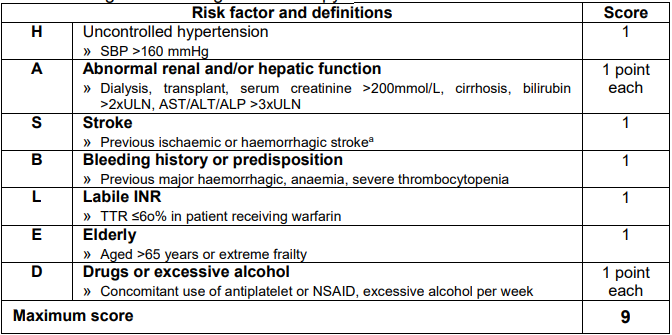
Click on image to enlarge
Table 2: HASBLED Score
a: Haemorrhagic stroke would also score 1 point under the “B” criterion.
b: Only relevant if patient receiving warfarin or other vitamin K antagonists
c: Alcohol excess/abuse refers to a high intake (e.g. >14 units per week) where the clinician assesses there would be an impact on health or bleeding risk Source: Hindricks G, Potpara T, Dagres N, Arbelo E, Bax JJ, Blomström-Lundqvist C, et al.; ESC Scientific Document Group. 2020 ESC Guidelines for the diagnosis and management of atrial fibrillation developed in collaboration with the European Association for Cardio-Thoracic Surgery (EACTS): The Task Force for the diagnosis and management of atrial fibrillation of the European Society of Cardiology (ESC) Developed with the special contribution of the European Heart Rhythm Association (EHRA) of the ESC. Eur Heart J. 2021 Feb 1;42(5):373-498. https://pubmed.ncbi.nlm.nih.gov/32860505/
- The formal assessment of bleeding risk identifies modifiable bleeding risk factors that should be managed and patients should be assessed at every visit.
- The higher the score, the greater the risk of bleeding.
- A high bleeding risk score should not lead to withholding oral anticoagulation therapy.
LoE:IIIaxlvi
Initial therapy aimed at stroke reduction
Anticoagulate with warfarin:
- Warfarin, oral, 5 mg daily.
- INR should be done after 48 hours, then every 1 to 2 days until within the therapeutic range of 2 to 3 (refer to Initiation dosing tables in Appendix II: Prescribing Information for Specific Medicines).
- Adjust dose to keep INR within therapeutic range (refer to Maintenance dosing tables in Appendix II: Prescribing Information for Specific Medicines).
- Every effort should be made to keep the time in therapeutic range (TTR) >65%. If TTR ≤65% there is less benefit of warfarin therapy and a greater risk of stroke and haemorrhage.
See Appendix II: Prescribing Information for Specific Medicines for guidance on calculating TTR for management with warfarin.
For therapy aimed at rate control
- Atenolol, oral, 50–100 mg daily.
- Contraindicated in asthmatics, heart failure.
OR
If in CCF: (I50.0)
- Carvedilol, oral. See Congestive cardiac failure.
AND
If control not adequate add:
- Digoxin, oral, 0.125 mg daily, adjust according to rate response and trough plasma level
- Digoxin trough plasma levels (before the morning dose) should be maintained between 0.6-1 nmol/L.
- Patients at high risk of digoxin toxicity: the elderly, patients with renal dysfunction, hypokalaemia, and patients with lean body mass
LoE:IVbxlviii
If beta-blockers are contra-indicated, e.g. asthma or severe peripheral vascular disease:
- Verapamil, oral, 40–120 mg 8 hourly.
- Titrate against ventricular rate (verapamil is negatively inotropic, therefore avoid in heart failure due to LV dysfunction).
LoE:IVbxlix
If not controlled on these agents, refer to specialist for consideration of alternative therapy, e.g.: amiodarone or atrioventricular node ablation and pacemaker insertion.
DC cardioversion may be needed in selected cases, after 4 weeks effective warfarin anticoagulation.
Long-term therapy
Continue warfarin anticoagulation long-term, unless contra-indicated:
- Warfarin, oral, 5 mg daily.
- Control with INR to therapeutic range:
- INR between 2-3 and patient stable: monitor every 2 months.
- INR <1.5 or >3.5: monitor monthly.
- Control with INR to therapeutic range:
LoE:IIIbl
|
Caution
Warfarin use requires regular INR monitoring and dose adjustment according to measured INR.
|
For rate control:
- Atenolol, oral, 50–100 mg daily.
- Contraindicated in asthmatics, heart failure.
If in CCF: (I50.0)
- Carvedilol, oral. See Congestive cardiac failure.
AND
If control not adequate add:
- Digoxin, oral, start at 0.125 mg daily and adjust according to rate response and trough plasma level.
- In patients with impaired renal function (eGFR < 60 mL/minute), consider 0.125 mg daily and adjust according to trough level monitoring.
- In all patients, digoxin trough level monitoring is required at all doses.
LoE:IIIbli
If beta blockers are contra-indicated, e.g. asthma or severe peripheral vascular disease:
- Verapamil, oral, 40–120 mg 8 hourly.
- Titrate against ventricular rate (verapamil is negatively inotropic, avoid in heart failure due to left ventricular dysfunction).
LoE:IVblii
If not controlled on these agents, refer to specialist for consideration of alternative therapy.
CAUTION
The risk of thromboembolic complications and stroke is similar to that of patients with persistent or paroxysmal atrial fibrillation and similar recommendations as to anticoagulation apply.
Only in patients with severe symptoms despite the above measures:
- Amiodarone, oral, 200 mg 8 hourly for 1 week. Specialist initiated.
- Followed by 200 mg 12 hourly for one week.
- Thereafter 200 mg daily.
LoE:Ialiii
Precautions:
- If on warfarin, halve the dose of warfarin and monitor INR closely, until INR is stable.
- Monitor heart rate closely when patient is on concomitant digoxin.
- Monitor thyroid function every 6 months as thyroid abnormalities may develop.
- Ophthalmological examination every 6 months.
For managament of pregnant women with valvular disease and atrial fibrillation, see Heart disease in pregnancy.
ATRIAL FLUTTER
I48.3-4/I48.9
Atrial rate >250 bpm with no flat baseline.
Can be difficult to recognise if 2:1 atrioventricular (AV) block, as the first of the two p waves preceding each QRS complex might be confused with the T-wave of the preceding beat. Vagal stimulation might slow the ventricular rate (usually approximately 150 bpm) and make the dysrhythmia more obvious.
Synchronised direct current (DC) cardioversion may be necessary in haemodynamic instability.
MEDICINE TREATMENT
DC cardioversion
DC cardioversion is the most effective therapy and administer midazolam as adjunct therapy:
- Midazolam IV, 1–2.5 mg, administered over 2-3 minutes.
For rate control therapies as for atrial fibrillation: see Atrial fibrillation.
CAUTION
Do not use verapamil as it will not convert flutter to sinus rhythm and may cause serious hypotension.
For anticoagulation as per the CHA2DS2-VASc score above: see Atrial fibrillation.
If flutter has been present longer than 48 hours, defer cardioversion until after 4 weeks’ anticoagulation with warfarin, unless severe symptoms or heart failure require urgent cardioversion.
Long-term therapy
Anticoagulants (see Atrial fibrillation.). Most consider that the thromboembolic risks in atrial flutter and atrial fibrillation are similar.
Rate control agents as for atrial fibrillation (see Atrial fibrillation.).
Recurrent atrial flutter is an indication for referral as many may be relatively simply cured by radio-frequency catheter ablation.
AV JUNCTIONAL RE-ENTRY TACHYCARDIAS
I47.0
Usually paroxysmal.
Often young patients with normal hearts.
AV nodal re-entry or atrioventricular re-entry (WPW syndrome).
P waves usually not visible (hidden by QRS complexes).
GENERAL MEASURES
Vagal manoeuvres: The modified Valsalva manoeuvre is the most effective – it should be done semi-recumbent with 15 seconds of strain, followed immediately by supine positioning and passive leg raising.
Carotid sinus massage: Should be done with the patient supine and as relaxed as possible.
MEDICINE TREATMENT
Initial therapy
If vagal manoeuvres fail:
- Adenosine, rapid IV bolus, 6 mg.
- Follow by a bolus of 10 mL sodium chloride 0.9% to ensure that it reaches the heart before it is broken down.
- Half life: ± 10 seconds.
- Run the ECG for 1 minute after the injection as a recording of method of cessation may be helpful diagnostically.
- If 6 mg fails, repeat with 12 mg.
- If this fails, repeat with another 12 mg.
- If the medicine reaches the central circulation before it is broken down the patient will experience flushing, sometimes chest pain, wheezing and anxiety.
- If the tachycardia fails to terminate without the patient experiencing those symptoms, the medicine did not reach the heart.
If none of the above is effective or if the patient is hypotensive, consider synchronised cardioversion.
Note:
Adenosine is contraindicated when atrial flutter is the obvious diagnosis, administration of adenosine can precipitate 1:1 conduction at ventricular rates 250–360 bpm and should be avoided.
LoE:IVb
Long term therapy
Teach the patient to perform vagal manoeuvres. Valsalva is the most effective.
For infrequent, non-incapacitating symptoms:
- Cardio-selective beta–blocker, e.g.:
- Atenolol, oral, 50–100 mg daily.
If asthmatic, without heart failure:
- Verapamil, oral, 40–120 mg 8 hourly.
LoE:IVbliv
Verapamil and digoxin are contraindicated in WPW syndrome.
REFERRAL
If the patient continues to experience debilitating symptoms refer for radiofrequency ablation.
WIDE QRS (VENTRICULAR) TACHYARRHYTHMIAS
DESCRIPTION
Sustained (> 30 seconds) or non-sustained wide QRS (> 0.12 seconds) tachycardias.
REGULAR WIDE QRS TACHYCARDIAS
I47.2/I47.9
Regular wide QRS tachycardias are ventricular until proved otherwise.
Regular wide QRS supraventricular tachycardias are uncommon.
Refer all cases after resuscitation and stabilisation.
Emergency DC cardioversion is mandatory with a full protocol of Cardio-pulmonary resuscitation (CPR) if there is haemodynamic compromise.
GENERAL MEASURES
CPR if necessary.
If no cardiac arrest:
DC cardioversion, 200 J, after sedation with:
- Midazolam IV, 1–2.5 mg, administered over 2-3 minutes.
- Monitor and repeat dose after 2-3 minutes, as necessary.
- If 200 J fails, use 360 J.
LoE:IVb
If cardiac arrest:
Defibrillate (not synchronised).
MEDICINE TREATMENT
Caution
Never give verapamil or adenosine IV to patients with a wide QRS tachycardia as this may precipitate ventricular fibrillation. LoE:IVblv
DC cardioversion is preferred and safest first line therapy for regular wide QRS tachycardias. Medicines are needed if ventricular tachycardia (VT) recurs after cardioversion, or spontaneous termination.
LoE:IVb
|
If in doubt as to the nature of a tachycardia, and in all patients with haemodynamic compromise, DC cardioversion under IV sedation is the safest option.
DC cardioversion, 200 J, after sedation with:
|
- Amiodarone, IV, 5 mg/kg infused over 30 minutes.
Follow with:
- Amiodarone, oral, 200 mg 8 hourly for 7 days.
- Then 200 mg 12 hourly for 7 days.
- Maintenance dose: 200 mg daily for the minimum time required to control the arrhythmia.
- Consult specialist before instituting long-term (>1 week) therapy.
LoE:IVblvi
Precautions:
- If on warfarin, halve the dose of warfarin and monitor INR closely, until INR is stable.
- Monitor heart rate closely when patient is on concomitant digoxin.
- Monitor thyroid function every 6 months as thyroid abnormalities may develop.
- Ophthalmological examination every 6 months.
REFERRAL
-
If no response to DC cardioversion, consult a specialist.
SUSTAINED (>30 SECONDS) IRREGULAR WIDE QRS TACHYCARDIAS
I47.0-2/I47.9
These tachycardias are usually due to atrial fibrillation with bundle branch block, or pre-excitation (WPW syndrome).
If the QRS complexes have a pattern of typical right or left bundle branch block, with a rate <170 bpm, treat as for atrial fibrillation. See Narrow QRS complex (supraventricular) tachycardias.
If the rate is >170 bpm, and/or the complexes are atypical or variable, the likely diagnosis is WPW syndrome with atrial fibrillation, conducting via the bypass tract.
Treat with DC cardioversion.
Do not treat with medication.
Verapamil and digoxin may precipitate ventricular fibrillation by increasing the ventricular rate.
| If in doubt as to the nature of a tachycardia, and in all patients with haemodynamic compromise, DC cardioversion under IV sedation is the safest option. DC cardioversion, 200 J, after sedation with:
|
NON-SUSTAINED (<30 SECONDS) IRREGULAR WIDE QRS TACHYCARDIAS
I47.0-2/I47.9
These tachycardias are usually ventricular. They are common in acute myocardial infarction. Check serum potassium level and correct if low.
MEDICINE TREATMENT
- Amiodarone, IV, 5 mg/kg infused over 30 minutes.
LoE:IIIblvii
Follow with:
- Amiodarone, oral, 200 mg three times a day for 7 days.
- Then 200 mg 12 hourly for 7 days.
- Follow with a maintenance dose of 200–400 mg daily, depending upon clinical judgement. Consult specialist before instituting long-term (> 1week) therapy.
Precautions:
- If on warfarin, halve the dose of warfarin and monitor INR closely until INR is stable.
- Monitor heart rate closely when the patient is on concomitant digoxin.
- Monitor thyroid function every 6 months as thyroid abnormalities may develop.
- Ophthalmological examination every 6 months.
OR
Only in haemodynamically stable patients:
- Lidocaine (lignocaine), IV, 50–100 mg (1–2 mg/kg) initially as a slow IV injection over 2 minutes.
- Repeat at 5 minute intervals if required to a total of 200–300 mg.
LoE:IIIblviii
Thereafter, for recurrent ventricular tachycardia only:
- Lidocaine (lignocaine), IV infusion, 1–3 mg/minute for 24–30 hours.
- Lidocaine will only terminate ± 30% of sustained ventricular tachycardias, and may cause hypotension, heart block or convulsions.
- For emergency treatment of ventricular tachycardia, DC cardioversion is first line therapy, even if stable.
In the absence of acute ischaemia or infarction, consider torsades de pointes, due to QT prolonging medicines.
TORSADES DE POINTES VENTRICULAR TACHYCARDIA (VT)
I47.2
Torsades de pointes Ventricular Tachycardia (VT) has a twisting pattern to the QRS complexes and a prolonged QT interval in sinus rhythm. It is usually due to a QTprolonging medication, active myocardial ischaemia and/or hypokalaemia and/or a history of alcohol abuse/malnutrition.
GENERAL MEASURES
Defibrillation, as necessary.
Torsades complicating bradycardia: temporary pacing.
MEDICINE TREATMENT
Stop all QT-prolonging medicines (a list of medicines that cause QT prolongation can be viewed at (https://www.sads.org.uk/drugs-toavoid/?doing_wp_cron=1672916576.0519239902496337890625)
Correct serum potassium.
- Magnesium sulphate, IV, 2 g administered over 5–10 minutes.
If recurrent episodes after initial dose of magnesium sulphate:
- Magnesium sulphate, IV, 2 g administered over 24 hours.
LoE:IVb
Torsades complicating bradycardia:
- Adrenaline (epinephrine) infusion to raise heart rate to > 100 bpm (if temporary pacing unavailable).
REFERRAL
All cases of wide QRS tachycardia, after resuscitation and stabilization.
HEART BLOCK (SECOND OR THIRD DEGREE)
I44.1/I44.2
DESCRIPTION
The majority of cases occur in patients >60 years of age and are idiopathic, with an excellent long-term prognosis, provided a permanent pacemaker is implanted. Acute, reversible AV block commonly complicates inferior myocardial infarction. Heart block may also be induced by metabolic and electrolyte disturbances, as well as by certain medicines.
GENERAL MEASURES
Emergency cardio-pulmonary resuscitation (if necessary).
External pacemaker should be available in all secondary hospitals and must be preceded by appropriate analgesia.
MEDICINE TREATMENT
Analgesia if external pacemaker:
- Morphine, IM, 10–15 mg 3–6 hourly.
- Apply relevant precautions as indicated in Appendix II: Prescribing Information for Specific Medicines (i.e. monitoring for response and toxicity).
AV nodal block with narrow QRS complex escape rhythm only:
- Atropine, IV bolus, 0.6–1.2 mg.
- May be repeated as needed until a pacemaker is inserted.
- Use in patients with inferior myocardial infarct and hypotension and second degree AV block, if symptomatic.
- It is temporary treatment of complete AV block before referral (urgently) for pacemaker.
OR
For resuscitation of asystole in combination with CPR:
I46.0-1/I46.9+(I44.1-2)
- Adrenaline (epinephrine) 1:10 000, slow IV, 5 mL (0.5 mg).
- Used as temporary treatment of complete heart block when other medicines are not effective.
REFERRAL
- All cases with a heart rate < 40 bpm after resuscitation and stabilization.
- All cases of 2nd or 3rd degree AV block, whether or not myocardial infarct or other reversible cause is suspected, and whether or not the patient is thought to be symptomatic.
- A permanent pacemaker is the definitive form of treatment. These are only available in tertiary institutions. Refer all symptomatic patients with significant bradyarrhythmias for evaluation.
SINUS BRADYCARDIA
R00.1
DESCRIPTION
This rhythm does not require treatment, unless it is causing symptoms, i.e. syncope, dizziness, tiredness and poor effort tolerance.
Sinus bradycardia < 50 beats per minute or sinus arrest with slow escape rhythm, accompanied by hypotension, strongly suggest a treatable underlying cause such as:
- acute inferior myocardial infarct,
- hyperkalaemia, especially if wide QRS and/or peaked T waves,
- medicines, especially combination of verapamil and ß-blocker or digoxin,
- hypothermia,
- hypoxia, or
- hypothyroidism.
Treat the cause. Consider atropine if inferior myocardial infarct.
SINUS ARREST
I49.5
Refer all urgently to a cardiologist.
Standard Treatment Guidelines and Essential Medicines List for South Africa, Adult Hospital Level, 2020-2024_Version 1.0_01 November 2024
Chapter 3: Cardiovascular System_3.3 Cardiac Dysrhythmias
Drugs mentioned
ICD-10 codes
- I44.1Atrioventricular block, second degree
- I44.2Atrioventricular block, complete
- I46.0Cardiac arrest with successful resuscitation
- I46.1Sudden cardiac death, so described
- I46.9Cardiac arrest, unspecified
- I47.0Re-entry ventricular arrhythmia
- I47.1Supraventricular tachycardia
- I47.2Ventricular tachycardia
- I47.9Paroxysmal tachycardia, unspecified
- I48.0Paroxysmal atrial fibrillation
- I48.1Persistent atrial fibrillation
- I48.2Chronic atrial fibrillation
- I48.3Typical atrial flutter
- I48.4Atypical atrial flutter
- I48.9Atrial fibrillation and atrial flutter, unspecified
- I49.5Sick sinus syndrome
- I50.0Congestive heart failure
- R00.1Bradycardia, unspecified