Hypokalaemia
Hypokalaemia
Introduction
Identification
Severity assessment
Management based on severity
Relevant history, examination
Investigations
Referral criteria
Discharge criteria
Treatment Algorithm
Introduction/ Description
Potentially life-threatening decrease in extracellular K+ concentration
Identification/recognition/diagnosis of problem
HypoK+ is often only retrospectively diagnosed. Where prospectively diagnosed the cues were taken from the history and examination that pointed to the underlying cause. Cause include:
- Excessive losses (Non-renal)
- Vomiting, diarrhoea, laxative abuse
- Gastro-intestinal fistula
- Excessive sweating in dry environments with prolonged exertion
- Redistribution from extra- to intracellular:
- Treatment of DKA (acute insulin administration)
- Drugs: ß2 Agonists, theophylline, caffeine, Amphotericin B, insulin overdose, decongestants, chloroquine overdose
- Hyperaldosteronism – Primary or Secondary hyperaldosteronism (CCF, Hepatic insufficiency, Nephrotic Syndrome)
- Hypokalaemic periodic paralysis
- Renal Potassium losses
- Drugs: Diuretics - Thiazide diuretics > loop and osmotic diuretics
- Distal Renal Tubular acidosis
- Magnesium deficiency
- Rare: Barrter, Gitelman and Liddle syndromes
Differential Diagnosis
- Bartter Syndrome
- Cushing Syndrome
- Hyperthyroidism
- Hypocalcaemia
- Hypochloraemic Alkalosis
- Hypomagnesaemia
- Metabolic Alkalosis
Severity assessment (Triage)
| K+ < 3.5 mmol/L = HypoK+ |
| K+ <2.5 mmol/L = Life threatening HypoK+ |
Management based on severity
Immediate action:
Non-drug treatment
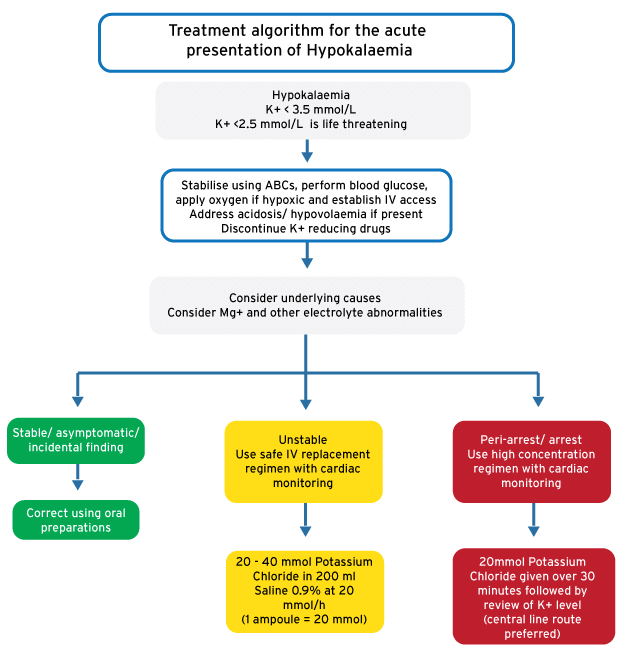
- Stabilise using ABCs, perform blood glucose, apply oxygen if hypoxic and establish IV access
- Address acidosis and treat hypovolaemia or volume deficits with Isotonic fluids if present
- Discontinue all drugs that may cause or worsen HypoK+
- Look for underlying cause of HypoK+
Drug treatment
- Safe replacement rate = 10 mmol per hour.
- 20 - 40 mmol Potassium Chloride in 200 ml Saline 0.9% at 20 mmol/h (1 ampoule = 20mmol). ALWAYS label fluid bag when adding K+
Note:High concentrations or more rapid administration should be done very carefully(preferably through a central line) with continuous cardiac monitoring.
Maximum dose 40mmol/hour in arrest/ peri-arrest situation (usually given as 20mmol over30 minutes followed by review of K+ level)
- In suspected or proven Hypomagnesaemia states and refractory Hypokalaemia replace Magnesium as well. Give 1-2 g Magnesium Sulphate over 20 minutes in 50-200ml Normal Saline. Don’t mix KCl and MgSO4 in same bag
- Oral replacement:
- Natural food sources: Dried fruit, Nuts, avocado, bananas, orange juice, white mushrooms, broccoli, spinach, French fries
- Oral K+ preparations: Potassium Chloride 40-100 mmol/day for treatment and 20 mmol/day for prevention of HypoK+ (other preparations: Potassium Bicarbonate, Potassium Citrate, Potassium Phosphate)
Relevant history, examination
- May present with: fatigue, weakness, progress to paralysis, ileus. Usually unremarkable examination and any findings made will depend on the underlying cause. General and systemic examination should be done to look for causes/ precipitants
Investigations
- Blood gas: the K+ level can usually be seen on the gas. Look for a metabolic alkalosis as well
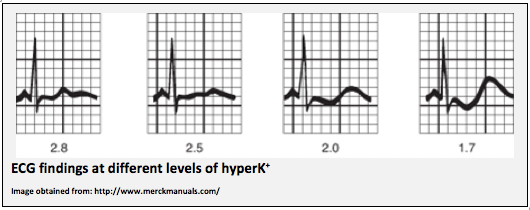
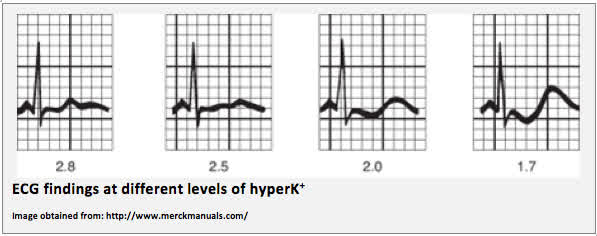
- ECG
- T waves flattened
- U waves
- Non-specific ST changes and T-wave inversion
- Cardiac arrest: PEA, Asystole
- Renal function: Look for HypoK+ and pre-renal failure
- Other investigations to be guided by the suspected underlying cause
Referral criteria
- Uncomplicated HypoK+ and HypoK+ due to reversible causes should be managed where presented. Stabilisation and initial correction of HypoK+ is also required whilst awaiting transfer to referral unit when indicated. Referral criteria include:
- Persistent HypoK+ despite optimal management
- Investigations as part of work-up not offered at current facility
- Conditions causing HypoK+ than can’t be manage at current facility
- If unsure whether to refer or not contact the Physician at your closest referring facility
Discharge criteria/checklist
- K+ Corrected
- Underlying cause found and treated/ corrected
- Drugs causing/ aggravating HypoK+ discontinued/ decreased
- Appropriate outpatient follow-up arranged
- Advise given on K+ containing foods: e.g. dried fruit, nuts, avocado, bananas, orange juice, white mushrooms, broccoli, spinach, French fries, etc.
- Consider oral K+ supplement for patients with very high risk of cardiac dysfunction/ arrhythmia
Treatment algorithm for the acute presentation of Hypokalaemia
References
Weiner DI, Wingo C. Hypokalemia – Consequences, causes and correction. J Am Soc of Neph 2012: 1179-1186
Cohn JN, Kowey PR, Whelton PK, Prisant M. New guidelines for Potassium Replacement in Clinical Practice. Arch Intern Med 2000;160:2429-2436
Rossiter D, Blockman M (eds.). South African Medicines Formulary. 11th Ed. Cape Town: Health and Medical Publishing Group; 2014
Cameron P, Jelinek G, Kelly A, et al. Textbook of Adult Emergency Medicine. 4th Ed. Elsevier; 2015
For further information on the drugs listed in the above guidelines, click on the drug name and you will be directed to the EMGuidance drug monograph.
Amphotericin B
Chloroquine
Magnesium Sulphate
Potassium Chloride
Theophylline